Translate

Showing posts with label engineering. Show all posts

Thursday, 4 April 2013

Composite Video Signal (CVS) - Horizontal sync details

Make sure you read the CVS in the order given below. Links to different CVS is given at end of this explanation.
There are 4 types of CVS viz.:
1. CVS for pedestal height
2. CVS for blanking pulses
3. CVS for horizontal sync detail
4. CVS for vertical sync detail

If in exam, a question comes as ‘Explain CVS’ then depending on the marks, explain anyone that you want to explain. For 5 marks, write any from first three. I’d prefer first one as it’s easy whereas if the question is for 10 marks, go for the 4th one. The one that I've explained below is the third one.

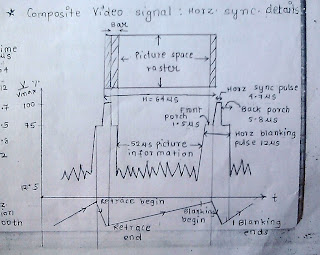
Click image to view full size

The total time required for horizontal trace and retrace is 64 µ seconds. Out of this 64 µ sec, 12 µ sec is line blanking period which means it takes 12 µ sec for retrace. During this 12 µ sec, a synchronizing pulse is added which is used to sync the horizontal scanning oscillator. This CVS explains how this 12 µ sec is actually divided.

The horizontal line blanking period is divided into three parts:
  1. Front porch of 1.7 µ seconds.
  2. Line synchronizing pulse of 4.7 µ sec.
  3. Back porch of 5.8 µ sec.
1.7 µ sec + 4.7 µ sec + 5.8 µ sec = 12 µ sec

Front porch:
This is known as front porch because it is added in front of the picture information. This front porch allows the receiver circuitry to settle down from whatever level exist at end of picture detail, to the blanking level before the synchronizing pulse occurs (the sync pulses are always added at the blank level). Saw tooth waveform is used for trace and retrace purpose. In the diagram below, the red line shows the time taken for the receiver circuitry to go to the blank level.

Click image to view full size

Line sync pulse:
After the front porch ends, the retrace begins. These line sync pulses are inserted in the CVS from transmitter’s side and are separated at the receiver. The main function of these pulses is to keep the transmitter and distant receiver in precise synchronization. The nominal time duration of this pulse is 4.7 µ sec. Apart from providing synchronizing, the horizontal scanning oscillator uses this pulse to complete its retrace. During this pulse, the beam completes its fly back and comes to the extreme left of the raster (screen) so that it can trace the next line.

Back porch:
This is known as the back porch because it is added the back side of the next picture information. It is nothing but an extension to the line sync pulse because this period of 5.8 µ sec allows plenty of time for the fly back to complete. Apart from this, it gives the horizontal scanning oscillator enough time to reverse the direction of current. During retrace, the current flows from left to right but for tracing the next line, the current should flow from right to left. For this, reversing the direction of current flow is needed.

Click image to view full size

The timing of back and front porch are so set that it creates black bars on right and left side of the raster.

To get CVS - Pedestal height, Click Here

To get CVS - Blanking Pulse, Click Here

To get me on FB, Click Here

Composite Video Signal (CVS) - Blanking Pulse

Make sure you read the CVS in the order given below. Links to different CVS is given at end of this explanation.


There are 4 types of CVS viz.:
1. CVS for pedestal height
2. CVS for blanking pulses
3. CVS for horizontal sync detail
4. CVS for vertical sync detail

If in exam, a question comes as ‘Explain CVS’ then depending on the marks, explain anyone that you want to explain. For 5 marks, write any from first three. I’d prefer first one as it’s easy whereas if the question is for 10 marks, go for the 4th one. The one that I've explained below is the second one.


Click the image for full view

Apart from picture elements, a CVS also contains blanking pulses. These pulses are used to make the retrace lines invisible. Retrace is nothing but the period when the horizontal scanning beam goes back to the left side of the raster (frame) and the vertical scanning goes to the top.

The adding of blanking pulse is done by increasing the video signal’s amplitude slightly above the peak black level. This means that they are added in blank level. Whenever a retrace is done, black spots are produced on screen. The blanking pulses are added at blank level so that no spots are observed on screen as blank level is darker than black level.

CVS contains horizontal as well as vertical blanking pulse to make the respective retrace invisible. The repetition rate for horizontal blank pulse, that is the period after which the next blank pulse will occur, is same as that of horizontal frequency that is 15625 Hz and the time period (TP) = 12 µ sec. Similarly, the repetition rate for vertical blank pulse is same as that of vertical scanning frequency that is 50 Hz and the time period (TP) = 160 µ sec.

To elaborate the answer, you'll can add the description of Peak White level, black level, blank level, etc.

To get CVS - Pedestal height, Click Here

To get CVS - Horizontal sync detail, Click Here

To get me on FB, Click Here

Composite Video Signal (CVS) - Pedestal height


Composite literally means ‘made up of various elements’. CVS has various elements like picture levels, sync pulses, etc. There are 4 types of CVS viz.:
1. CVS for pedestal height
2. CVS for blanking pulses
3. CVS for horizontal sync detail
4. CVS for vertical sync detail

Make sure you read the CVS in the order given above. Links to different CVS is given at end of this explanation.

If in exam, a question comes as ‘Explain CVS’ then depending on the marks, explain anyone that you want to explain. For 5 marks, write any from first three. I’d prefer first one as it’s easy whereas if the question is for 10 marks, go for the 4th one. The one that is explained below is the first one.


Click the image to view it in full size.

A video signal is nothing but sequence of images stitched together. A CVS contain many video signals which means a CVS has different brightness levels depending upon the scene.

As video signals have various images, it is obvious that they will have various colour components. So in a video signal, the maximum whitness to be handled is known as Peak White level. This level is situated at 12.5% of the maximum value of the signal. For example if a signal having 100 volts amplitude is transmitted, then the peak white level for that signal will be at 12.5% of 100 = 12.5 volts.

Just like the white level, a CVS has black and blank level also. Black level is at 72% and blank level is at 75% of the maximum value of the signal. The synchronizing pulses, pulses that are used for keeping the horizontal and vertical oscillator in sync, are added at the blank level. The black level is used for separating the blank level from the picture information.

The difference between black level and blank level is known as pedestal and the difference between pedestal and DC value of the signal is known as the pedestal height. DC value of a signal is nothing but the average value of that signal.

To further elaborate the answer, you'll can add the details of horizontal and vertical sync pulses by stating their time duration, trace time, etc.

To get CVS for blanking pulse, Click Here

To get CVS - Horizontal sync details, Click Here

To get me on FB, Click Here

Sunday, 31 March 2013

Engineering - Blessing in disguise!


I've never come across anybody who has said anything good about engineering to me.
If I'm to frame this the other way, I can say that everybody whom I've come across, has criticized engineering to the core. If you are one such person who is pursuing engineering and still hates it, then let me say that I'm really against such thinking.
Not many of engineering students realize the amount of knowledge that engineering has given them. I'm from Electronics and telecom's department so I'll be talking with reference to things that I've studied.
Before stepping into engineering, who knew that basic blocks or the heart and brain of our Personal Computers (PCs) and Laptops are microprocessor and microcontroller? It is engineering who introduced us to these chips!
We all know that every time when a mobile phone is switched on, we cannot use it for few moments. A layman doesn't know the reason that why his/her mobile doesn't respond after he/she turns it on but we know that the processor in the mobile is initializing itself and so it has disabled all its interrupts. And we know about this because we have studied MicroProcessor and MicroContorller (MPMC) in engineering.
Communicating via mobile phone is something that even a 5th grader knows but how exactly this communication takes place, is known to us. We know the difference between a home circle and a roaming circle because we've studied mobile communication. 
TV is something that we've been watching right since our childhood but it is engineering that has shown us the real concept behind this box. It is engineering who taught us that image transmission takes place just by generation of electrons depending upon the brightness levels of the scene.
Many students argue that in this era, when companies are launching LED/LCD TVs, we are busy learning CRT TVs. Why don't those people realize that without understanding basic TV how, can they think of studying LED or LCD?!
Coming to the Comps/IT field, students from this background should be proud of IT giants like Google, Facebook, Microsoft and Twitter. And I am sure students from various other fields like Mechanical, Electrical, Civil etc. are awestruck with the development in their respective fields.
So I would like to conclude this article by saying that if we stop criticizing engineering and start utilizing the knowledge that this field has to offer us, we can do really well. 

NOTE:
No where in this article I have said that engineering is superior to any other field. The amount of knowledge that this field gives us is surely high but that does not mean that other fields like commerce or arts is in any way inferior to us. Remember, if our knowledge about technology is better then their knowledge about economy and other such things, is far better than ours :)

To get me on FB, Click Here